For centuries, humanity assumed that the laws of physics were eternal.
Gravity worked yesterday. It works today. It will work tomorrow. Simple.
But modern physics contains a deeply unsettling possibility:
What if the laws themselves can change?
Think about water. Below 0°C, it becomes ice. Above 100°C, it becomes steam. The underlying molecules stay the same. But the rules governing their large-scale behavior change dramatically.
Physicists now wonder whether the universe itself may have experienced similar transitions.
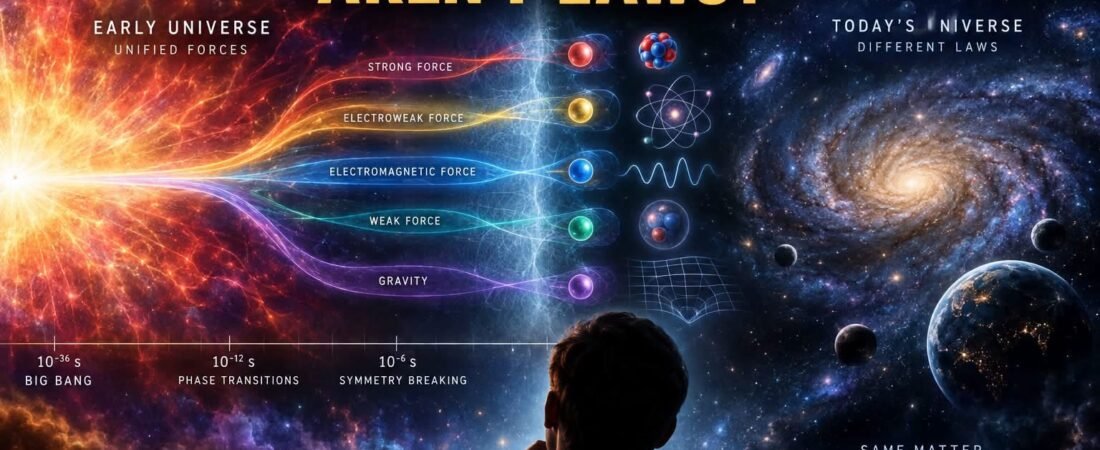
In the earliest moments after the Big Bang, nature may have passed through a series of cosmic phase transitions. During those transitions, the forces of nature may have looked completely different.
Electricity and the weak nuclear force were once unified. Some theories suggest that all known forces may once have been aspects of a single underlying structure.
As the universe cooled, symmetries broke. New laws emerged. New particles appeared. Reality reorganized itself.
This idea leads to a disturbing question: Were the laws of physics discovered… or were they created?
Perhaps the constants we measure today are not inevitable. Perhaps they are frozen relics of ancient cosmic transitions.
A different transition might have produced a completely different universe. Different particles. Different chemistry. Different stars. Perhaps no life at all.
Modern cosmology even allows the possibility that different regions of a larger cosmic landscape could settle into different vacuum states, each with its own effective physical laws.
This remains speculative. But it is serious enough that physicists actively investigate it through particle physics, cosmology, quantum field theory, and studies of the Higgs field.
Think about the consequence. Every atom in your body depends on a delicate balance of constants and interactions.
Change them slightly and atoms fail. Stars fail. Chemistry fails. Life fails.
The universe you call home exists because reality settled into this particular set of rules.
And perhaps the strangest possibility of all is this: The laws of physics may not be timeless truths. They may be cosmic fossils. Ancient remnants of events that occurred long before the first star was born.
Sources
- The Future of Higgs Boson Physics, Michael E. Peskin, arXiv:2601.02729.
- The Higgs Boson: Its Implications and Prospects for Future Discoveries, Steven D. Bass et al., arXiv:2104.06821.
- Anti De Sitter Space And Holography, Edward Witten.
- Emergent Holographic Spacetime from Quantum Information, Tadashi Takayanagi, Physical Review Letters (2025).
- Modern cosmology, symmetry breaking, Higgs-field physics, and early-universe phase-transition literature.