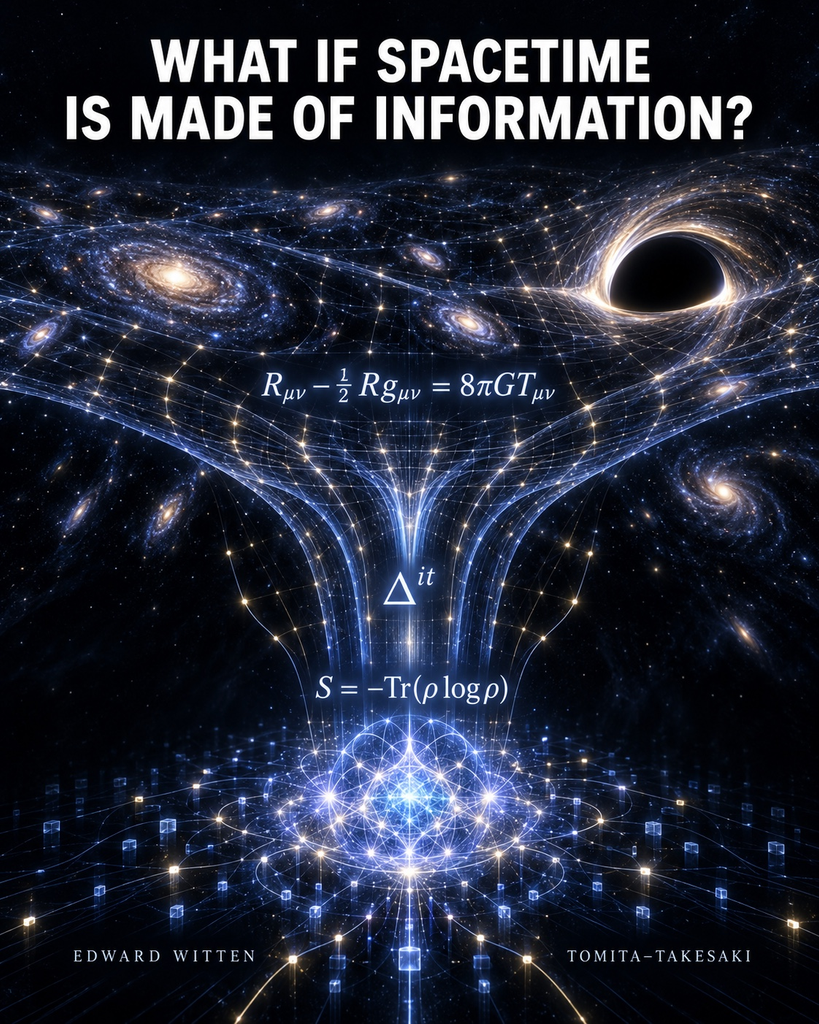
Some of the deepest ideas in modern theoretical physics suggest that spacetime may emerge from quantum information, entanglement and algebraic structure.Read the full article
For decades, physicists have treated space and time as the fundamental stage on which reality unfolds. But what if spacetime itself is not fundamental? What if the universe emerges from something deeper?
This possibility lies at the heart of several influential research programmes in modern theoretical physics, many connected to the work of Edward Witten, one of the most influential mathematical physicists of our time.
Beyond Space and Time
Traditional physics treats spacetime as the background structure of reality. Work in string theory, quantum gravity and holography suggests a different picture. In several modern frameworks, geometry may emerge from quantum information, entanglement and deeper algebraic structures.
The universe may not ultimately be built from particles moving through a pre-existing space. Instead, space itself may arise from relationships between quantum systems.
The Holographic Revolution
One of the most remarkable developments in theoretical physics is the holographic principle. According to this idea, the physics inside a volume of space may be encoded by a theory defined on a lower-dimensional boundary.
In simple terms, a higher-dimensional gravitational world can, in certain theoretical settings, have an equivalent lower-dimensional description. This does not establish that our everyday three-dimensional cosmos is literally a projection on a physical outer wall. It is a mathematically precise duality in specific models and an important clue about quantum gravity.
Witten’s Lasting Influence
Edward Witten did not merely contribute to string theory. His work connected geometry, topology, quantum field theory and gravity in ways that continue to shape modern research.
Researchers now ask whether spacetime emerges from quantum entanglement, whether gravity can be understood through information, and whether parts of the universe can be reconstructed from algebraic relations rather than fundamental geometric objects.
A New Picture of the Universe
The next revolution in fundamental physics may reveal that spacetime is not the foundation of reality but a consequence of something deeper. If that happens, future historians may look back at ideas developed by Witten and his contemporaries as part of the beginning of a new scientific worldview.
The greatest mystery of the cosmos may not be what exists inside space and time. It may be why space and time exist at all.
Scientific status: Emergent spacetime and holographic duality are active areas of theoretical research. They provide powerful results in specific mathematical frameworks but are not a confirmed description of our universe as a whole.
Sources • Maldacena, J. (1998). The Large N Limit of Superconformal Field Theories and Supergravity. • Van Raamsdonk, M. (2010). Building Up Spacetime with Quantum Entanglement. • Witten, E. (1995). String Theory Dynamics in Various Dimensions. • Witten, E. (2022). Why Does Quantum Field Theory in Curved Spacetime Make Sense?
Maldacena · arXivVan Raamsdonk · arXivWitten 1995 · arXivWitten 2022 · arXivLike1Share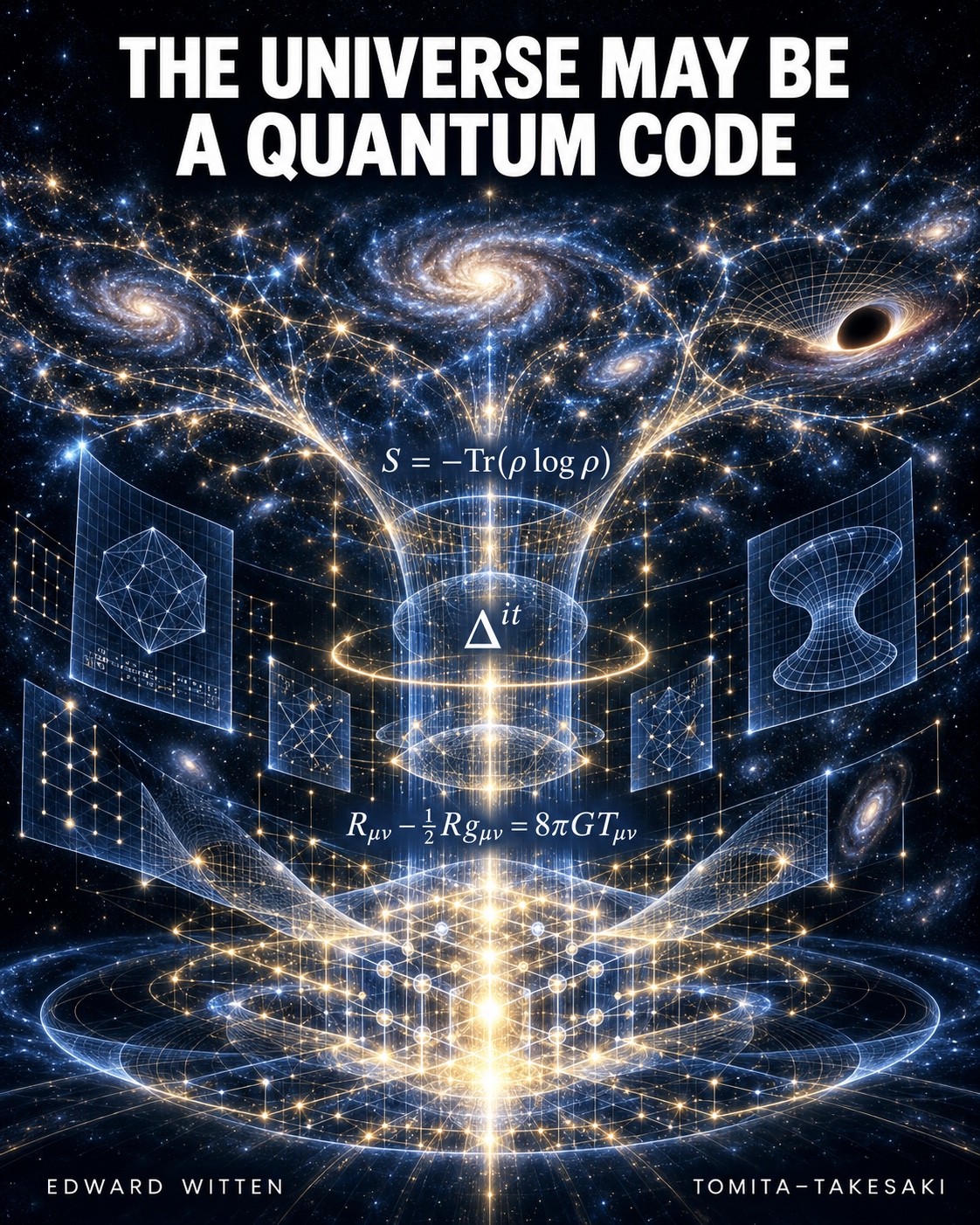
Holography · Quantum Information7 September 202610
The Universe May Be a Quantum Error-Correcting Code
The mathematics used to protect information in quantum computers also appears in models connecting a gravitational bulk to its holographic boundary.Read the full article
AKARŞEN KAAN
The truest guide in life is science.The official website of Arşen Kaan
BooksTheoretical WorkMedia & PressContactZenodo