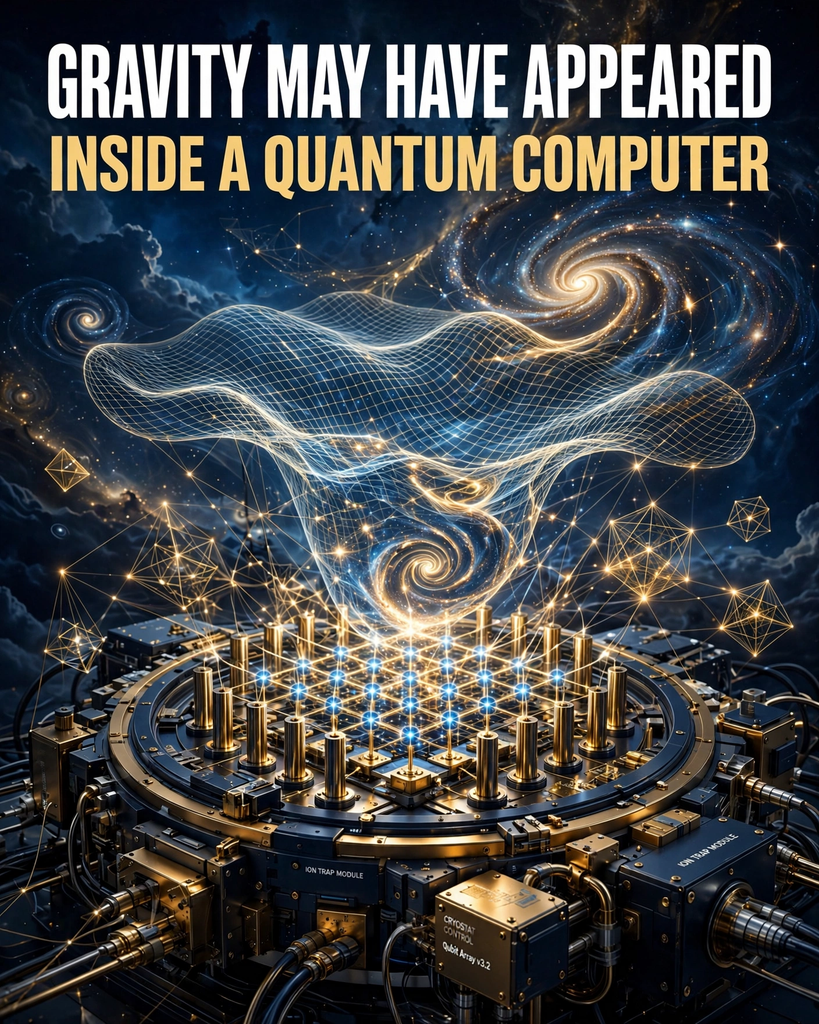
The experiment did not create real gravity, spacetime or a traversable wormhole. Researchers implemented the HaPPY code—a simplified holographic quantum error-correcting model—on a trapped-ion quantum computer.
In their 2026 preprint, the team reported an experimental test of the Faulkner–Lewkowycz–Maldacena relation inside this model. They then introduced non-stabilizer resources, often called magic, and measured entropic precursors expected in models of emergent gravity.
The researchers also built a code construction whose entropic behavior resembles that of a highly quantum wormhole. “Resembles” is essential: no tunnel through physical spacetime was opened and no object was transported. This was an analogue simulation of mathematical relationships in a controlled quantum system.
The result matters because parts of the quantum-information language used in holographic gravity can now be examined experimentally rather than only through equations. Quantum processors may therefore become useful testbeds for simplified models of emergent geometry.
But the HaPPY code is not a complete model of our universe, and the experiment does not prove that spacetime is made of quantum information. The careful conclusion is that a quantum computer reproduced selected gravity-like signatures predicted within a particular holographic toy model.
Biswas et al. · arXiv:2607.12047