From Newton to the Brain, From Evolution to Redshift
When we say “colors do not really exist”, the statement is often misunderstood.
It does not mean that light is not physically real. Light exists. Electromagnetic waves exist. Photons exist. Wavelengths exist.
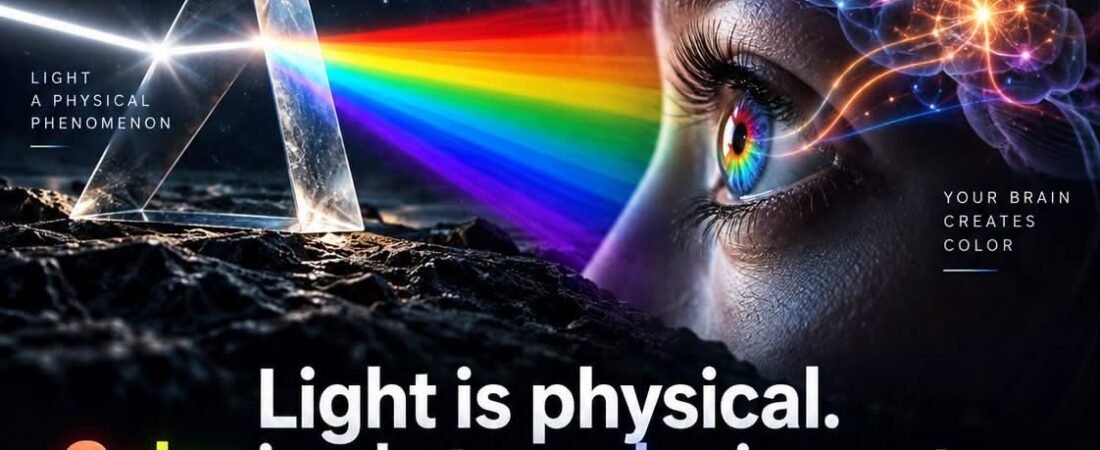
But the subjective experience we call “red,” “blue,” or “green” is the way the brain interprets those physical signals.
For example, when light with a wavelength of roughly 700 nanometers reaches your eyes, photoreceptors in the retina respond in particular proportions. Those signals are converted into electrical activity and transmitted to the brain. The brain processes them, and the result is the experience: “I see red.”
So the external world contains a measurable electromagnetic spectrum. But “redness” itself is a perceptual experience generated by the nervous system.
Newton Revealed the Physical Basis
In his famous prism experiments in the 17th century, Isaac Newton passed white light through a glass prism. A spectrum appeared, ranging from red to violet.
Newton’s crucial insight was this: the prism was not creating the colors. White light already contained components that were refracted by different amounts. The prism merely separated them.
This became one of the foundations of modern optics. But the physical spectrum produced in Newton’s experiment and the color experience generated inside our brain are not the same thing. One is the physical stimulus. The other is perception.
Why Does the Brain Create Color?
Because color vision is extraordinarily useful from an evolutionary perspective.
The brain’s task is not to construct a perfect physical copy of the universe. Its task is to extract information that is useful for survival.
Distinguishing ripe fruit from leaves. Detecting an animal against its background. Recognizing subtle changes in faces. Identifying objects despite changing illumination and shadow.
Over millions of years of evolution, different species developed visual systems that use electromagnetic information in different ways.
That is why not every organism sees the world the way humans do. Bees can detect ultraviolet radiation. Many birds possess photoreceptor systems that allow them to discriminate colors humans cannot distinguish. Certain snakes can detect infrared radiation thermally using specialized pit organs.
The same physical world. But very different biological perceptual systems.
Then What Is Redshift?
In astronomy, redshift refers to the shift of light toward longer wavelengths. For example, light traveling from very distant galaxies through an expanding universe can undergo cosmological redshift.
This is not a visual illusion produced by the brain. There is a measurable physical change in the wavelength of the radiation. A spectrograph can measure that shift even when no human eye is involved.
Therefore: redshift is a physical phenomenon. But our experience of certain wavelengths as “red” is a neurobiological phenomenon.
The Most Important Distinction
Color is not an independent substance or fundamental physical property contained inside objects. It is a perceptual experience that emerges from the interaction between electromagnetic radiation and the visual nervous system.
A tomato’s surface reflects some wavelengths more strongly than others. That reflectance spectrum is physically measurable. But without a visual system capable of processing those signals, there would be no subjective experience of “redness” in the sense that humans experience it.
This is where physics and neuroscience meet.
What if the photoreceptors in the human eye and the visual cortex had evolved differently? We could be living in exactly the same electromagnetic universe while experiencing it through completely different color categories.
The universe would not change. Light would not change. But the world we experience could look completely different.
The sky has a physical spectrum. A rose has a measurable reflectance spectrum. Stars have identifiable spectral lines. But the experience that makes them appear blue, red, or yellow arises inside the brain.
Perhaps the world we see is not a literal photograph of external reality. Perhaps it is a biological model of physical reality constructed by the brain.
For Readers Who Want to Go Deeper into Physics
In my books published in Germany, I explore these questions in much greater depth — from the foundations of modern physics to quantum theory and the deeper structure of physical reality.
My work also covers modern physics, quantum reality, modular time, and cosmology, alongside my research publication “A Rigorous Modular-Time Coordinate in the Weyl-Coherent Rindler Sector.”
The English edition of my book is coming soon.
For readers interested not only in the equations of physics, but also in the deeper question “What is reality, actually?”, these books are written precisely for that journey.