
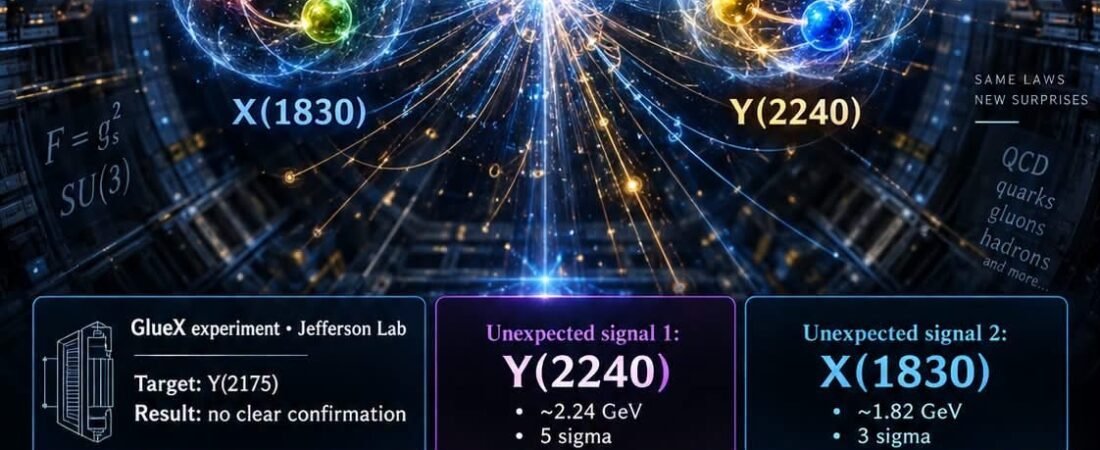
And neither fits neatly into the Standard Model.
In the 1960s, physicists faced a growing problem: new particles were being discovered almost every year. So many, in fact, that it became increasingly difficult to make sense of them.
Historians later referred to this period as the “particle zoo” or “hadron zoo.”
Then Murray Gell-Mann proposed the quark model. Beneath the apparent chaos were smaller building blocks: quarks. That model suddenly brought order to the zoo.
Today, physics may be facing a new one.
Since 2003, particle experiments have discovered a growing number of short-lived states that do not fit comfortably into the conventional quark–antiquark or three-quark picture. These are often called exotic hadrons.
Many of them carry names such as X, Y and Z — labels that reflect how uncertain their underlying structure still is.
Now, physicists working with the GlueX experiment at Jefferson Lab have reported something unexpected.
They went looking for one previously reported XYZ candidate. Instead, they found evidence for two different structures.
Using a high-energy photon beam directed at a liquid-hydrogen target, the researchers investigated the so-called strangeonium region — states involving strange and antistrange quarks.
One of their main goals was to search for the previously reported Y(2175) state. But Y(2175) did not clearly appear.
Instead, two other structures emerged.
The first, Y(2240), appeared near 2.24 GeV with a reported statistical significance of about 5 sigma.
The second, X(1830), appeared near 1.82 GeV with a significance of roughly 3 sigma.
Researcher Frank Nerling described the situation this way: “We are in a new era here, similar to 70 years ago. First, a hadron zoo was discovered. Now we are facing a zoo of exotic states.”
Lead researcher Malte Albrecht added that the team had originally been searching for an XYZ candidate using a photon beam, but instead found two different structures.
That is new information.
Why Does This Matter?
The Standard Model provides the framework for known elementary particles and their interactions.
But the internal structure of many XYZ states remains difficult to explain using the simplest conventional hadron picture.
Some may be tetraquarks, containing four quarks. Others could be hadronic molecules, loosely bound combinations of other hadrons. Some candidates may involve direct excitation of the gluonic field, producing so-called hybrid mesons.
And some signals could ultimately turn out to have more conventional explanations.
Understanding these states could reveal important details about quantum chromodynamics, or QCD — the theory describing the strong nuclear interaction that binds quarks together and ultimately helps hold atomic nuclei together.
In the 1960s, the quark model helped solve the original hadron zoo. Could today’s exotic-particle zoo eventually require another conceptual breakthrough of similar scale?
Or is the answer hidden even deeper inside the dynamics of the strong force?
Scientific caution: The reported evidence for X(1830) and Y(2240) is significant, but the precise nature of these structures is not yet settled. Whether they represent genuinely exotic hadrons, conventional resonances, interference effects, or other phenomena remains an open question. Independent confirmation and further analysis will be essential.
Sources
- GlueX Collaboration, Physical Review Letters (2026) — Jefferson Lab / GSI Helmholtz Centre
- ScienceDaily, September 2, 2026
- Phys.org
- SciTechDaily